Whole-Home Standby Generators for Plymouth
Plymouth covers more ground than any other town in Massachusetts, and Eversource has to work its way out to every mile of it before your road comes back on. A standby generator answers that on its own, with nobody home and nobody standing in the rain. Tyler Hopkins is a Generac dealer and a factory warranty technician, so the same person who sizes and installs your unit is the one who services it years later.
Why an Outage Here Runs Long
Plymouth is the largest town by land area in the state, and that single fact shapes every storm. When a nor’easter comes off Cape Cod Bay and drops limbs across the wooded roads inland, crews have miles of line to walk before they get anywhere near the far ends of town. The streets nearest the substations come back first. The outer roads wait.
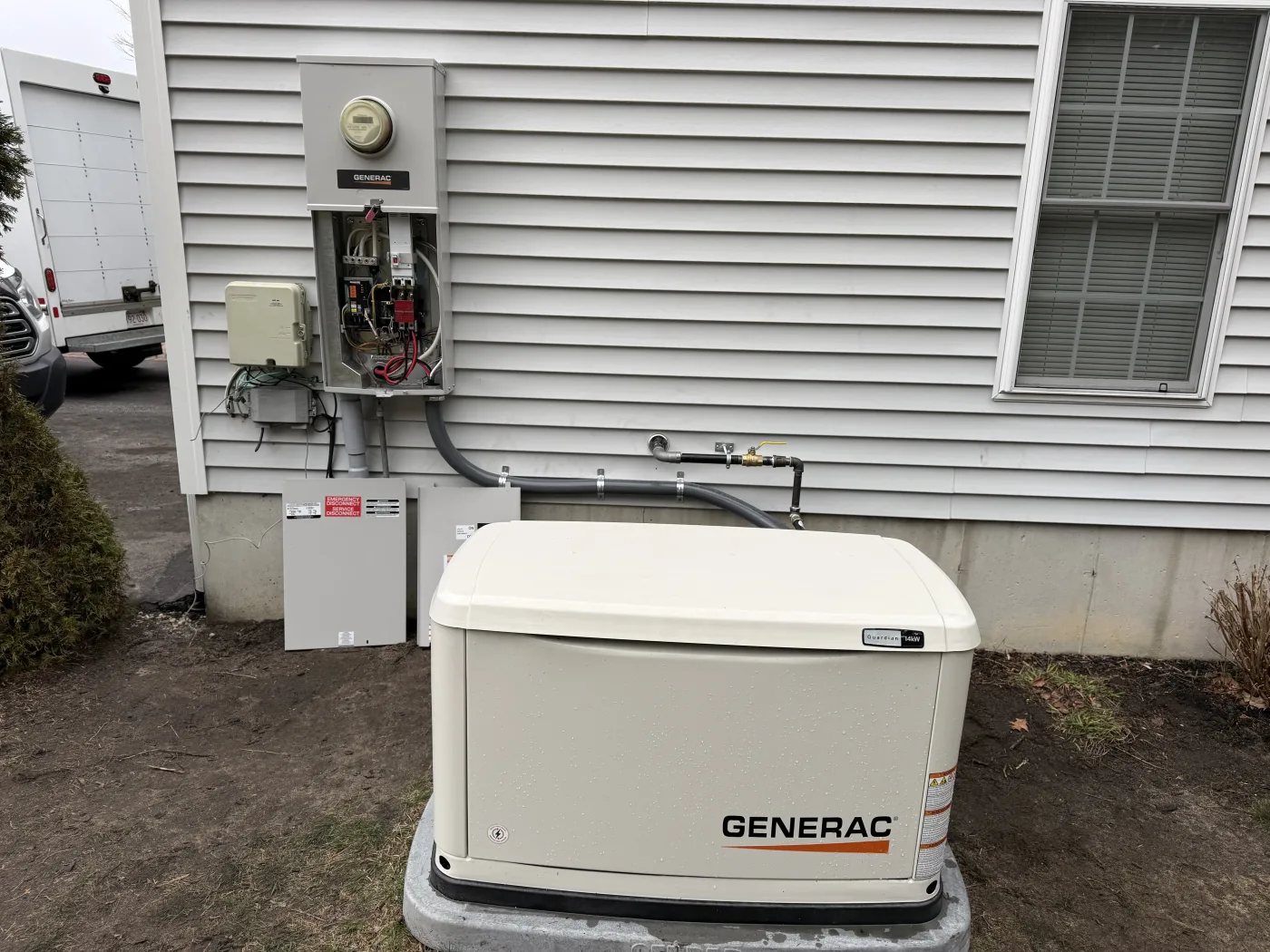
A whole-home standby unit takes the waiting out of the equation. It is permanent equipment: a machine on a level pad outside the house, plumbed to a fuel supply, watching utility power around the clock. When the grid drops, the transfer switch cuts your house loose from the line and the engine starts on its own, usually inside half a minute. When the street comes back, the switch hands the load over and the engine shuts down.
Inland Plymouth runs heavily on private well and septic, and that changes the arithmetic of an outage. No power means no pump, which means no water at the tap, no shower, and no flush. A house on a well with electric heat can be unlivable by the second morning, and even on town water the sump pump, the boiler controls, and the freezer all stop when the meter does.
Then there are the houses nobody is standing in. Manomet, White Horse Beach, and Priscilla Beach are full of places that see a family for part of the year and nobody the rest of it. A February outage in an empty house is the one that ends with a split supply line and a ceiling on the floor, because there was nobody home to notice the heat had quit. Backup power keeps the boiler and the pump alive whether anyone is there or not.
What a Generac Warranty Technician Means After the Truck Leaves
We are a Generac dealer, which lets us sell and install the equipment, and a Generac factory warranty technician, which is the part worth slowing down on, because it matters long after installation day. Warranty repairs have to be performed by an authorized technician for the coverage to hold, so when the shop that installed your unit is not one, a fault code turns into a phone tree and a wait for somebody who has never seen your installation. Here, the man who ran the numbers and set the pad is the man who comes back and opens it up. Tyler pulls the permit under his own Master Electrician license and registers every unit with Generac at start-up.
Sizing is where generator jobs go sideways, in both directions. Plenty of outfits pick a model off the square footage of the house and call it settled. We run a real load calculation on your panel instead: what is actually on it, what starts under load, and what has to run at the same time on a January night. A well pump pulls hard the instant it kicks on, and so does a compressor. Sometimes the honest answer is a smaller unit than somebody else quoted you, and we would rather say so.
The other half of the decision is the transfer switch. A whole-house switch backs up the entire panel and lets the home run the way it already runs, which suits the newer places out at the Pinehills and Cedarville with central air and a couple of zones. A managed switch protects the loads you truly need in an outage, heat, the well or sump pump, refrigeration, and lighting, and sheds the rest as the engine gets busy.
Either way the switch lands on your service, so we look hard at the panel before quoting anything. A generator is only as good as the gear it feeds, and a tired or undersized service is a poor place to bolt on new equipment. If yours needs work we will say so and price the panel work alongside it.
Fuel, Placement, and the People Next Door
Natural gas reaches some parts of Plymouth and not others, so the fuel conversation starts with your street. If gas already serves the house, that is usually the simpler path, but the existing line and meter have to carry the added demand. A generator is a large appliance, so the gas sizing gets checked rather than assumed. Where there is no gas, propane runs a standby unit perfectly well; the trade is a tank that has to live somewhere sensible and get filled. We settle the fuel side with the utility or a licensed plumber before anything is ordered.
Placement gets its own visit. The unit needs clearance from windows, doors, vents, and the meter, it needs a level pad, and a sensible run back to the panel. On the close lots downtown and near the waterfront, where the houses date to the eighteenth and nineteenth centuries, that puzzle takes some thought, and we solve it standing in the yard with you. Salt air is the other local factor: anything mounted outdoors in the shore neighborhoods gets corrosion-resistant hardware. Modern air-cooled units are quiet enough that a well-placed machine never becomes a neighbor problem, and we set the weekly self-test for a civilized hour.
Book a walk-through for your Plymouth home
Tyler runs the load calculation himself and hands you a written fixed price. Permit, pad, transfer switch, and factory start-up are in the scope.
Questions Plymouth Homeowners Ask Us
How do you decide what size unit we need?
With a load calculation, not a rule of thumb. Tyler opens the panel and looks at what starts under load and what has to run together on a January night. Well pumps and compressors draw hard the moment they kick on, and that inrush drives the sizing more than square footage does.
We are on well and septic. Does that change the plan?
It raises the stakes. Without power you have no water at all, not simply no lights, and the pump is one of the heaviest loads in the house. We make sure it lands on the protected side of the transfer switch and that the unit can carry its start-up draw alongside heat and refrigeration.
Does the Town of Plymouth require a permit?
Yes. The electrical permit is pulled under Tyler’s Master Electrician license, and the pad and installation are typically permitted as well. We book the inspection and close the permit out once the work passes. Skipping that step tends to resurface at a closing or during an insurance claim.
What does the weekly exercise cycle involve?
The unit starts itself on a set day and time each week, runs a few minutes to circulate oil and keep the battery up, then shuts down. Past that it is a small engine: oil, filter, plugs, and battery on an interval set by run hours. We go through the schedule at start-up, and we service what we install.
Our place in Manomet sits empty most of the winter. Is it worth it?
That is the house we worry about most. An outage nobody is present for is how a heating system quits and a pipe lets go, discovered weeks later by a neighbor. A standby unit keeps heat and the pump running with the house closed up, and the weekly self-test means it is not sitting dead when it is finally needed.
How loud is it on a tight lot downtown?
Air-cooled Generac units are far quieter than the portable machines most people remember, and they only run during an outage plus one short self-test a week. On a close lot we walk the placement with you first, hold the required clearances, and set the test time so it is not firing up early on a Sunday.
Other Work We Do Around Plymouth
See recent installs · Book a walk-through · Call Tyler at (508) 818-3165
Where We Work in Plymouth
Hopkins Electric installs Generac standby systems from the downtown waterfront out through Manomet, Cedarville, and the Pinehills, twenty-five miles east of our Taunton shop.