North Attleborough Whole-Home Generators
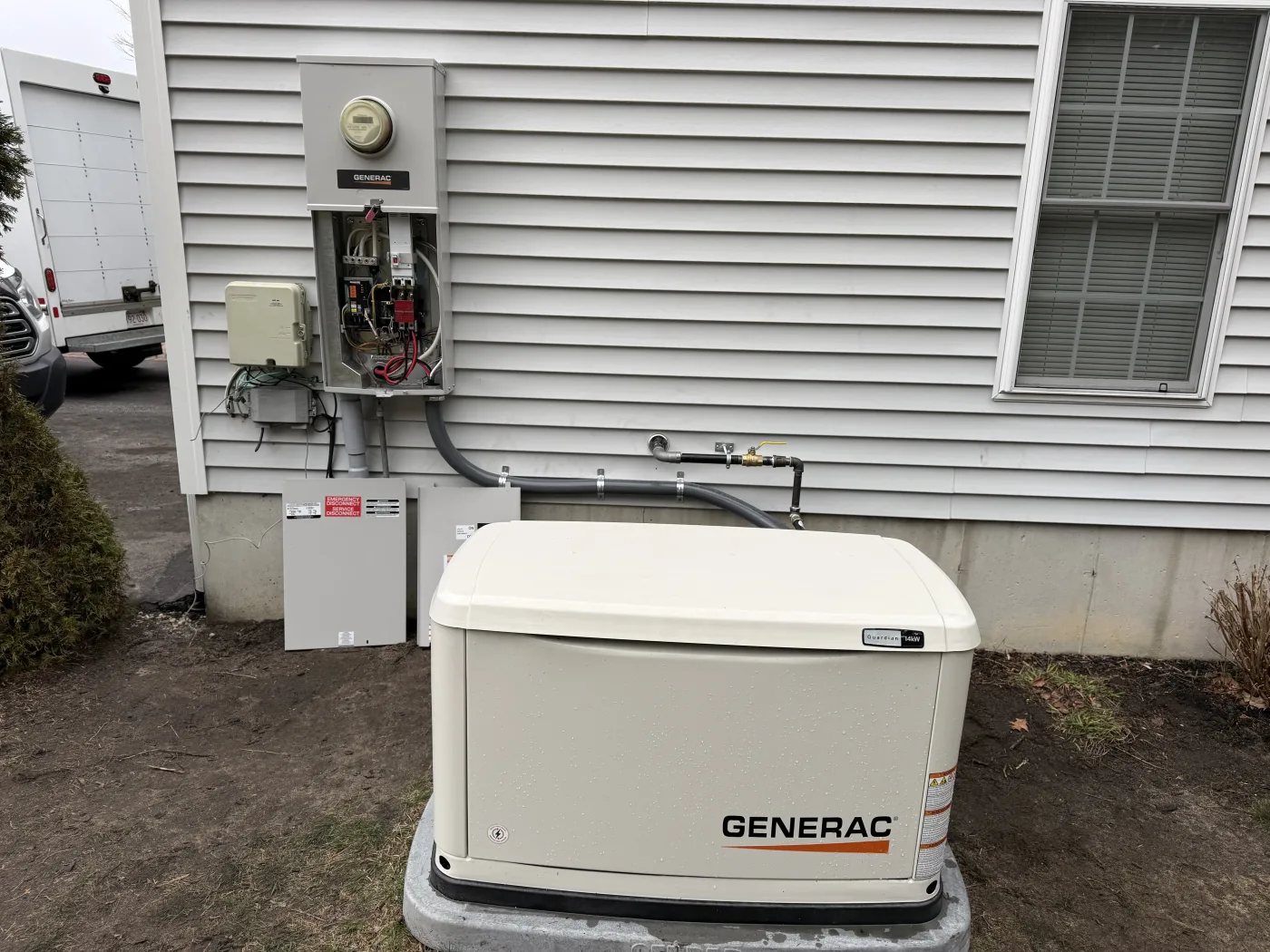
A standby unit sits quietly on a pad beside the house until the street goes dark, then picks up the load on its own while nobody is home to flip anything. Hopkins Electric sizes, sets and wires those systems for North Attleborough families who would rather not spend a February night watching the thermostat drop. Tyler quotes the job himself and pulls the permit in his own license.
Storm season decides how long you sit in the dark
New England hands out its outages on a schedule you cannot plan around. A wet March snow bends limbs onto a distribution line, an August cell tears through with straight-line wind, and a coastal storm keeps crews busy somewhere else for a day and a half. The lights blink twice and then stay off, and everything in the house that quietly depends on electricity stops being quiet about it.
A standby system takes that whole chain of consequences off the table. It watches the incoming utility feed all the time, and when the voltage drops out it starts on its own, transfers the house over, and carries the load until the utility comes back clean. Then it hands the house back and shuts itself down. If you want to talk through what your outages have actually looked like, send Tyler the details and he will read them before he ever quotes a unit.
Sizing starts with what your house actually runs
The conversation starts in the basement, at the panel, with the door open. Tyler reads the breakers, asks what each one feeds, and separates the circuits that have to stay alive from the ones that can wait until Tuesday. Heat and its controls almost always make the list. So do the refrigerator and freezer, the sump, the well pump for houses off town water, the internet and a working set of lights and outlets. Ranges, dryers, hot tubs and central air are where the honest conversation happens, because those are the loads that push a unit up a size or two.
Motors get their own attention. A well pump or a compressor draws several times its running current for the first half second, and a unit that only covers the steady numbers will stumble or drop out the first cold night you lean on it. Undersizing shows up exactly when you need the thing, which is the worst possible time to learn about it. Oversizing is its own kind of waste, since you pay for capacity that never leaves the driveway. Getting the number right in the middle is the entire job, and it is why the quote comes after the walk-through instead of over the phone.
The transfer switch is what makes it automatic
People shop for the engine and forget the part that does the thinking. The automatic transfer switch is what separates a standby system from an expensive lawn ornament: it senses the utility going away, tells the generator to start, waits for it to come up to speed, and only then moves the house over. It also keeps the two power sources apart, which is the safety piece, since backfeeding a line that a utility crew is working on is a way to hurt somebody blocks away.
Choosing the switch usually pulls the panel itself into the conversation. If the existing service is tired, crowded, or a brand insurers dislike, it is far cheaper to sort it out while the walls and conduit are already open than to come back and redo it later. Tyler will say so plainly if that is the case, and the panel work gets quoted as its own line so you can see what each piece costs instead of getting one blended number. The same logic applies if a car charger is anywhere in your plans, because it is far easier to make room for both at once.
Where the unit sits and how it gets fuel
Placement gets settled on site, with a tape measure, before anything is ordered. A standby unit needs clearance from windows and doors so exhaust cannot find its way indoors, breathing room from the wall and from anything combustible, and a level pad that will not settle sideways after two winters. It also has to live somewhere that makes sense to your neighbors, because it runs a test cycle every week and you will both hear it.
Fuel is the other half. Natural gas is the simplest arrangement where the street has it, since the unit taps the supply you already pay for and never needs refilling or watching. The sizing of that supply matters, though, because a generator under load asks for a lot of gas at once and a line that feeds a furnace comfortably may not feed both. Where there is no gas at the street, propane does the same work off a tank, and the tank gets sized so a multi-day outage does not end in a delivery call. Either way the fuel side is planned alongside the electrical side, by the same person, so the two halves agree before the crew shows up.
Permits, startup and the service it needs every year
The permit gets pulled in the Electrician’s name on every job that requires one, which is not a formality. It means an inspector looks at the bonding, the transfer switch and the conductors before anything gets buttoned up, and it means the paperwork on your house is clean when you sell it or when an insurance question comes up years from now. Tyler is a Massachusetts Master Electrician, licensed in 2024, and Hopkins Electric is fully insured and bonded. The shop is also a Generac dealer and a Generac certified warranty technician, so the same people who sized and set the unit are the ones the manufacturer authorizes to service it under warranty, which is the annual visit this section is about.
After that it is an engine sitting outdoors, and engines want attention once a year. Oil and filter, a battery that gets load-tested instead of eyeballed, plugs and air filter on schedule, a look at the transfer switch and its connections, and confirmation that the weekly exercise is still happening. The battery is the usual culprit when a standby unit fails to start, and a battery that is fine in July can be finished by January. Catching that in the fall costs a service call. Finding it during an outage costs you the whole reason you bought the thing.
Questions North Attleborough homeowners ask first
How soon could you get out to look at the job?
The town falls inside our 35-mile radius from Taunton, so it is regular territory rather than a special trip. Two to four business days is the usual wait for generator, mini split or panel work. Anything urgent, meaning no power, exposed wiring or a burnt outlet, jumps the line and is often handled same-day.
Does the whole house come back on, or only part of it?
Either, and it is your call once you see what each costs. Covering a chosen list of circuits, usually heat, water, the food and some lights, keeps the unit smaller than covering everything. Tyler lays out both after reading your panel so you are choosing between two real numbers.
How loud is it, and how often does it run?
It runs a short self-test on a set day each week, and you can hear it from the yard the way you hear a car idling. We schedule that test for a civil hour rather than early morning. During an actual outage it runs continuously, which nobody minds much when the neighbors are dark.
Do I need to be there while it is being installed?
Only for the walk-through at the start and the handover at the end. In between, most of the work happens outside at the pad and inside at the panel, and we tell you the day before exactly when the house will be down.
Who handles the permit and the inspection?
We do. Permits are pulled in the Electrician’s name on every job that requires one, and Tyler attends the inspection himself rather than sending somebody who was not there for the install. That is included in the scope, not billed as a surprise afterward.
What is the fastest way to get a real answer on my house?
Text Tyler at (508) 818-3165 or send the details through the contact form. Tell us the age of the house, whether you are on town water or a well, and what you lost in the last outage, which is usually enough to say what range of unit fits before anyone drives out.
Talk it through before the next storm, not during one
Tyler walks the panel, reads the loads, and puts a written quote in your hands with the unit, the switch, the pad, the permit and the startup all named. Backup power is one of those purchases that gets made in a hurry after a bad week, and hurried is the expensive way to buy it. Call or text and we will find a time that works, or send the project details and we will come back to you with real questions rather than a form letter. Recent Bristol County work is in the gallery if you want to see how the finished installs look.
More electrical work around North Attleborough
All North Attleborough services · Bristol County coverage · Recent projects · Every town we cover