North Attleborough EV Charger Installation
A car that charges overnight at home is the whole point of driving electric, and getting there in North Attleborough usually means one honest look at the service you already have. Tyler Hopkins reads the meter, the panel and the route to where you park before a single part gets ordered, then writes a fixed price you can hold him to.
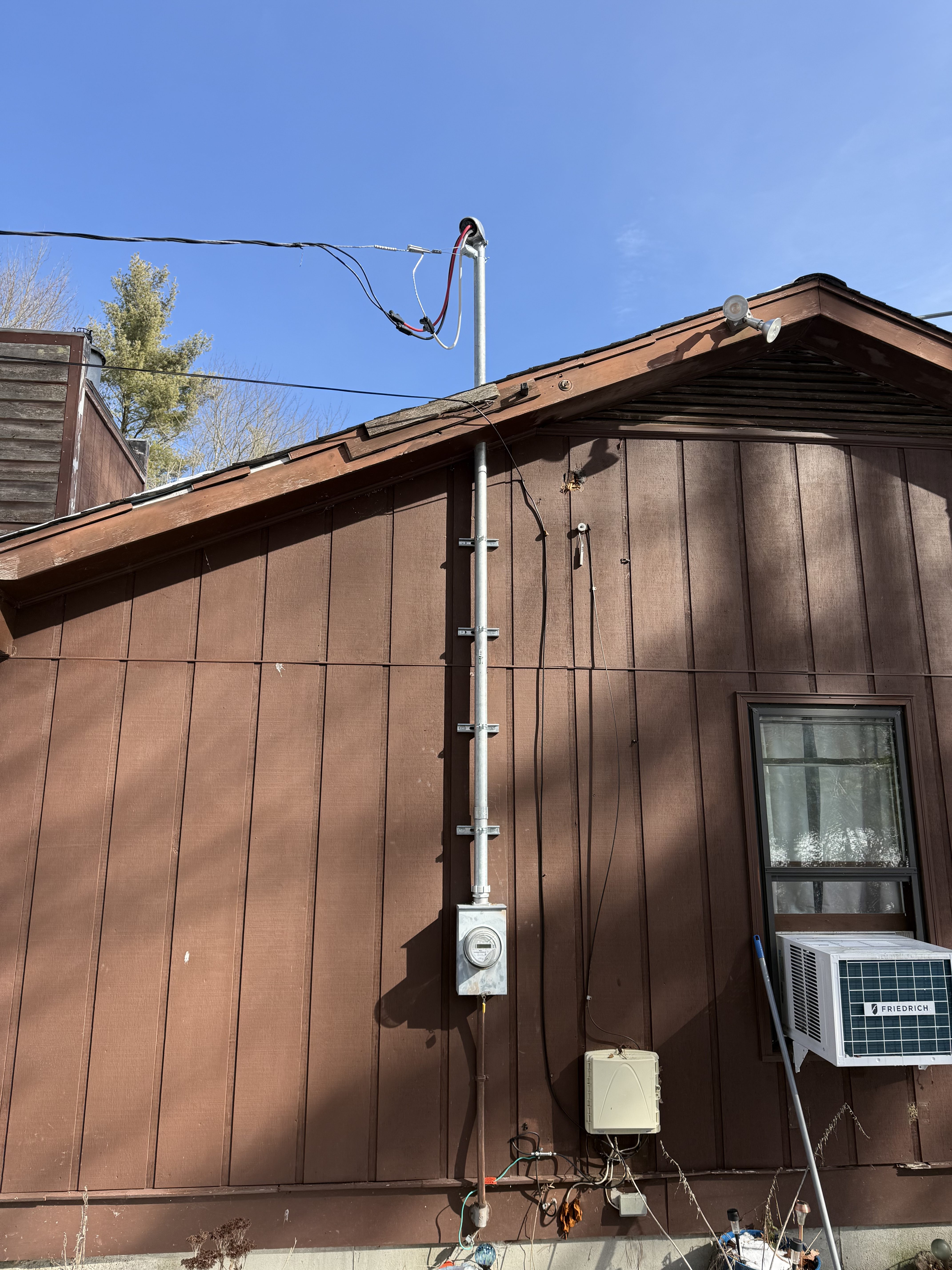
Why the meter and the panel get read first
Homeowners usually call after the car has been ordered, with a delivery date circled on the calendar and a charger already sitting in a box in the hallway. That order is fine. What cannot be skipped is the half hour Tyler spends at the outside wall and the panel before anything is scheduled, because a charger pulling forty amps for six hours straight is the single heaviest thing most houses will ever be asked to run.
What he is reading is simple enough to explain at the wall. How many amps the incoming service actually carries, what the meter and mast look like where they land on the siding, how much of the panel is already spoken for by a range, a dryer, a well pump or a heat pump, and whether there is a spare double slot or the busbar is full. Older lots around town frequently answer that last question with a no, and there is no point pretending otherwise until the numbers are on paper.
Once those numbers exist, every path forward is a real choice instead of a guess. Sometimes the service is generous and the job is an afternoon. Sometimes the panel is tight and there are two clean ways around it. Either way you get a written quote that names the circuit size, the wire, the route and the charge rate you will actually see, and you decide with the whole picture in front of you rather than halfway through a demolished wall.
Getting power out to a detached garage or the far end of a driveway
Plenty of houses in this part of Bristol County were laid out long before anyone imagined parking a car that needed feeding. The panel sits in a corner of a fieldstone or poured basement, and the car sits at the end of a driveway or inside a garage that stands on its own out back. Between those two points is the part of the job that separates a clean install from an eyesore.
Tyler walks that distance with you before quoting it. Sometimes the shortest line is straight out the rim joist and along the foundation to a post near where you park. Sometimes it means picking up an existing feed to the garage that was sized for a light bulb and a door opener, which almost never carries a charger without being redone properly. Trenching is on the table when the run has to cross open ground, and so is a small subpanel in the garage when there is other work you would like out there eventually.
The finish matters as much as the route. Straps land on layout lines, the conduit gets bent rather than kinked, penetrations are sealed against wind-driven rain, and the unit hangs plumb at a height where the cable reaches the port without lying in a puddle. This is a fixture on the front of your house for the next fifteen years, so it should look like someone meant to put it there.
Hardwired or plug-in, and how to tell which one you want
Two ways to land a home charger. A plug-in unit hangs on a heavy receptacle and can be unplugged and carried off; a hardwired unit is fed straight into the wiring with no cord cap and no outlet in the middle. Both are legitimate, and the honest answer depends less on the hardware than on what you plan to do with the house.
Go plug-in if the charger might move with you, if you rent, or if you expect to swap brands in a couple of years and want the circuit to outlive the box on the wall. Go hardwired if this is the house you are staying in. A hardwired unit removes the receptacle and the cord cap, which is where heat and corrosion tend to show up first on a circuit that runs near its limit night after night, and it lets some models deliver their full rate rather than the lower one a plug-in setup is held to.
Exposure decides a lot of it too. On an outside wall the receptacle route needs a weatherproof enclosure with a gasketed cover, one more assembly in the weather that a hardwired connection simply does not have. Tyler installs both and will tell you plainly which he would put on his own wall given where yours ends up. You can read more about how he approaches residential electrical work in North Attleborough, or send him the details and get a written quote back.
Charger showing up before the wiring is sorted?
Text Tyler a photo of the panel and where you park. He will tell you what the house can carry.
Equipment that survives a Massachusetts winter outdoors
An outdoor charger in Massachusetts spends its life under conditions that are hard on hardware. Salt and sand come off the road all winter, temperatures swing forty degrees across a February week, ice loads the cable and the holster, and summer sun bakes the same enclosure that was frozen solid five months earlier. Cheap equipment fails on that cycle, and it fails in January when you need the car most.
So the outdoor spec is deliberate. The unit itself has to be rated for wet locations rather than merely covered by a roof overhang, and the cable has to stay flexible in real cold instead of turning into a length of pipe you fight with in the dark. Enclosures, fittings and the disconnect are chosen to match. Where a unit mounts on a post rather than a wall, the post is set to stand up to a plow-thrown bank of snow and a bumper that finds it eventually.
Mounting height and cable management do the rest of the work. Hang the holster high enough that the connector never sits in slush, run the cable so meltwater sheds away from the port instead of into it, and orient the unit so the display is readable with a glove on. Small decisions, and they are the difference between a charger you stop thinking about and one you resent every storm. Recent installs are in the project gallery.
Load management when the service is already full
The most common finding on an older lot is a service with no room left. That is not the end of the conversation, and it does not automatically mean tearing out the meter and mast and going to two hundred amps. There is a middle path worth understanding before you commit to the expensive one.
Load management puts a device between the charger and the rest of the house that watches total draw in real time. When the dryer, the oven and the water heater all fire at once, the charger throttles back or pauses; when the house quiets down for the night, it takes everything that is available. Since a car sitting in the driveway from evening until morning has hours to work with, most drivers never notice the throttling at all, and the car is full when they leave.
It is not the right answer for everyone. If you are already planning a heat pump, a hot tub or an addition, or you are running two electric cars off one house, the service upgrade is the honest recommendation and Tyler will say so. That work is covered on the panel upgrade page. What you will not get is a service upgrade sold to you because it is the bigger ticket. The load calculation decides, and you see it.
Questions before booking a charger install
How soon could you get out here?
North Attleborough sits inside the 35-mile radius from Taunton, so a walk-through is easy to schedule. Work like this typically lands within two to four business days. If you have lost power or something is burning or arcing, that jumps the line and is often same-day.
My panel looks full. Is a charger off the table?
Almost never. A full-looking panel and a service with no capacity are two different problems, and the load calculation tells them apart. Tandem breakers, a small subpanel, or a load-management device solve most of these without touching the meter or the mast.
Can the charger go on the detached garage out back?
Yes, and it is a common request here. The existing feed to an older garage was usually sized for lighting and a door opener, so expect it to be replaced rather than reused. Tyler walks the run, prices the trench or the overhead route, and puts it in the written quote.
Do you handle the permit and the inspection?
Yes. Permits are pulled in the Electrician’s name on every job that requires one, and Tyler is there when the inspector comes. A charger on an inspected circuit is documented when you refinance or sell, which a dryer-outlet workaround never is.
Should I buy the charger myself or have you supply it?
Either is fine. Plenty of people buy the unit with the car or catch a sale, and that is no trouble at all. Send the model number before the walk-through so the circuit gets sized to that specific unit rather than to a generic assumption.
Are you licensed and insured?
Tyler earned his Massachusetts Electrician license in 2024, and the company carries full insurance and a bond. He runs the walk-through, writes the quote, does the work, and stands in front of the inspector himself. There is no crew to hand you off to.
Other electrical work around North Attleborough
Every service in North Attleborough · Bristol County coverage · All towns we cover
Book the walk-through and get the price in writing
The fastest way to move on this is to text Tyler at (508) 818-3165 with a photo of your panel and a photo of where the car parks. He can usually tell from those two pictures whether you are looking at a straightforward afternoon or a conversation about capacity, and he will say which before anyone drives out.
From there the walk-through is free and the price comes back in writing, with the circuit, the wire, the route and the charge rate spelled out so nothing is left to interpretation. North Attleborough is a short run from the Taunton shop, so scheduling is rarely the holdup. Send the details through the contact form if that is easier than a call.