The size of the machine is the last decision, not the first. What comes first is a load calculation on your actual service, and then an honest conversation about which circuits you want awake. Whole house means the machine covers everything and nobody thinks about it. Partial means a chosen list of circuits, a smaller unit, and a household that has agreed in advance about what stays dark. The transfer switch is what turns either answer into reality.
Most people arrive at this with a number in their head. A neighbor has a 22, somebody at work says get the 24, a chart on a website says a house your size takes a certain size unit. Then a load calculation gets done on the actual service and the number moves, sometimes down.
That is the part worth understanding before you shop, because the wattage on the label is the cheapest thing to change and the hardest thing to guess at from a distance.
What a Load Calculation Actually Decides
A load calculation is not a tally of everything you own. It works from your service size, the square footage, and then the specific things in your house that draw heavily and unpredictably: well pump, electric range, electric dryer, central air, heat pump, electric water heater, hot tub, an EV charger if there is one.
The reason those get named individually is that running watts are not the problem. Starting watts are. A well pump or an air conditioner compressor pulls several times its running draw in the moment it kicks on, and a generator has to absorb that spike without dipping voltage far enough to bother everything else in the house. Two homes with identical square footage can land on different units because one has a deep well and the other is on city water.
The calculation also decides whether anything about your existing service needs attention first. If your main is undersized, or your load center is full, or the panel is a brand insurers ask about, that surfaces here rather than on installation day. Sometimes the honest sequence is a panel upgrade and then a generator, and it is cheaper to learn that in the walk-through.
Whole House Is Really a Statement About Decisions
A whole house system means the transfer switch sits between your meter and your entire load center, so when the utility drops, the machine carries the house as it is. Nobody has to remember what is allowed. Nobody discovers at 2am that the bedroom they moved into is not on the backup.
The trade is size. A house with electric heat, central air and an electric range asks a lot, so a whole house answer in that house is a larger unit than the same footprint with gas heat and a gas range. Load management hardware can soften this by shedding the air conditioning for a moment when the well pump starts, which lets a smaller machine cover a bigger house honestly rather than on paper.
Whole house also makes the most sense in a household that is not going to police itself. Kids, tenants, an elderly parent, a home office with equipment nobody wants to explain. If you cannot reasonably expect everyone in the building to remember the rules during a nor’easter, the machine should not depend on them remembering.

Partial Means Somebody Picks the List
A partial system covers a selected set of circuits through a smaller transfer switch, and a smaller machine. For a lot of Taunton houses it is genuinely the right call, and for some it is a decision people regret by the second outage.
The usual list is heat, the well or the boiler controls, the refrigerator, a few lighting circuits, the sump pump, and one or two outlets for phones and a router. That keeps a house habitable and dry, which is what most of the damage risk in a New England outage comes down to.
What comes off the list is where the honesty matters. Central air is usually out, which is fine in February and much less fine in a summer outage. The electric range is usually out. The second floor bedrooms are often out. The dryer is out. In older colonials the circuits are frequently not organized the way you would want them to be, so getting the kitchen refrigerator onto the backup can mean waking up three other things that share its circuit, or moving that circuit, which is work.
The question I would ask before choosing partial: can you name, right now, the six circuits you want, and does everyone living in the house agree? If the answer is yes, partial is a good and rational choice. If you find yourself wanting to say “well, and also,” that is the load calculation telling you something.
Service Rated or Not, and Why It Changes the Wall
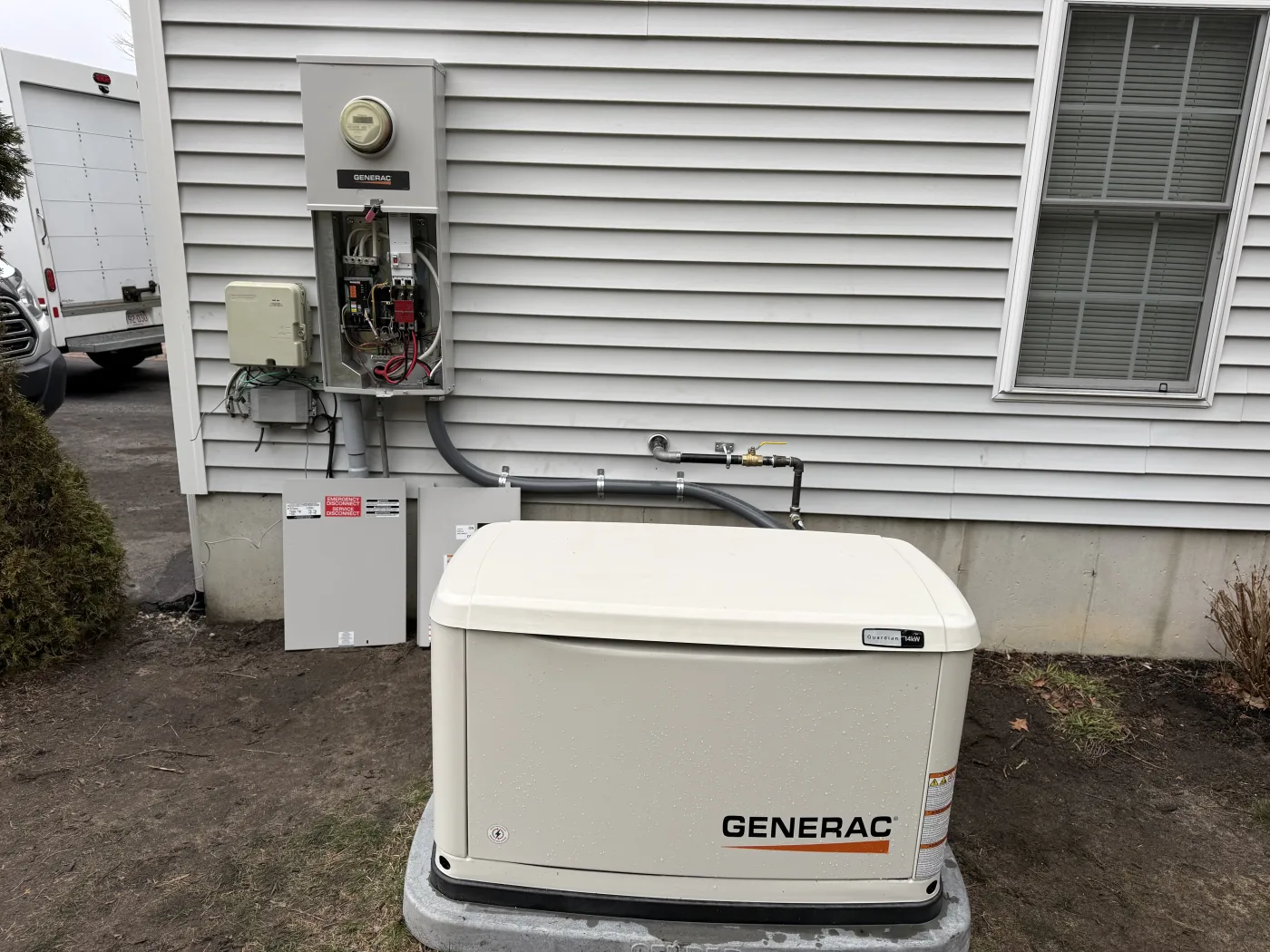
Transfer switches come in two arrangements and the difference shows up in your basement, not on a spec sheet. A service rated switch contains the main disconnect, so it sits ahead of your load center and becomes the first thing utility power touches inside the house. A non service rated switch sits after an existing main, which means your current service equipment stays where it is and the switch goes beside it.
Which one you end up with is mostly decided by what is already on the wall. Plenty of houses here have a meter outside, a main inside, and a load center that has been added to twice. On a stone foundation wall with limited flat backing, finding a plumb, reachable, code clearance spot for another enclosure is a real measurement, and it is worth doing before anyone quotes a number rather than after.
The other number to ask about is circuit count on a partial switch. A ten circuit switch and a sixteen circuit switch sound similar and are not. Furnace, well pump, refrigerator, a couple of lighting circuits and the kitchen receptacles will consume ten before you have thought about the freezer in the garage or the sump. If your list is already at the limit on paper, it will be over it in practice, because the circuit you forgot is always the one that matters.
Load management is the part that lets a smaller machine behave like a larger one. Rather than sizing for everything running at once, a load shed module watches the big draws and sheds one when another starts, most commonly dropping the air conditioning for the moment the well pump kicks in. It is not a trick. It is an honest way to keep a unit smaller, and it is worth knowing whether a quote includes it, because two quotes that look far apart are often a switch and a shed module apart.
Fuel Is the Taunton Complication
Natural gas availability here varies street to street, and sometimes house to house on the same street. A unit on natural gas runs as long as the gas holds, never needs filling, and is the simplest thing to live with. If your street has gas at the curb but your house does not have a service, that is a separate conversation with the gas utility and it has its own timeline.
Propane is the answer for most houses without gas, and it works well. It changes two things: you own a tank, and the tank has to be sized for the run time you actually want. A tank that runs a house for a day is a different tank than one that runs it for four days, and the placement has clearances to respect. Cold weather also affects how much a propane tank can deliver, which matters precisely when you need it.
The older housing stock around here brings the rest of it. Gas meters in awkward spots, a service entrance that has been rearranged twice, a pad location that has to clear windows and the dryer vent and the oil fill. None of that is difficult. All of it is why the size conversation happens at the house rather than over the phone, and why our generator installation work starts with a walk-through and not a catalog page.
Questions People Ask Before They Buy
Can I start partial and go whole house later?
Sometimes, and it depends entirely on the switch and the unit you started with. A partial transfer switch does not become a whole house switch, so that piece gets replaced. If you think whole house is where you will end up, say so during the load calculation and we will size the switch and the pad for it now even if the machine comes later.
Is a bigger unit always the safer choice?
No. An oversized generator spends most of its running life lightly loaded, which is not good for the engine, and you paid for capacity you never use. The point of the load calculation is to find the size that absorbs your worst starting spike without being permanently underworked. Right sized beats oversized.
What happens to the central air on a partial system?
On most partial systems it stays off, because the compressor start is the single largest spike in a typical house and covering it drives the size up considerably. If summer outages matter to you, say that early. Load management can sometimes get the air conditioning onto a smaller system by shedding it briefly when something else starts.
The useful order is this: get the load calculation, look at the two lists side by side, and decide what you want your household to be thinking about during an outage. Then pick the machine. Existing units get looked after too, and generator repairs and annual service stay with the same person who installed it.
Get the number from your panel, not from a chart
Tyler is a Generac dealer and a certified warranty technician, so the sizing, the install and anything the unit needs later all stay in one place. He runs the load calculation at the house and shows you both options with the circuits named, priced out line by line: unit, switch, pad, permit.
Free Quote Call Tyler (508) 818-3165Generator installation · Panel upgrades · Every service in Taunton · Recent installs