Almost every question people type in after an outage is really one question: is this the utility’s problem or mine. There is a line at your meter. Everything on the street side of it belongs to the utility, which in Taunton is TMLP. Everything past it belongs to you, and it behaves differently. Once you can tell which side you are looking at, you know whether to wait or to pick up the phone.
The lights come back and the house does not come back with them. The porch light is on, the microwave is blinking, the bedroom outlets are dead. Or the refrigerator hums again but the back half of the first floor is dark. Or you flip a breaker that clearly tripped and it will not stay up.
Those are the searches that happen at nine in the morning after a night without power. Each one is a clue about which side of your service the trouble sits on.
Half the House Came Back and Half Did Not
A typical home here is fed by two hot legs coming in from the street plus a neutral. Your panel splits its breakers between those two legs. If one leg is lost anywhere along the way, roughly half your circuits go dead and the other half work perfectly, which is exactly what you are seeing. Nothing inside your panel tripped, so there is nothing obvious to reset, and that is why it feels like a mystery.
The reassuring version is that the leg is lost out on the utility side, at the transformer or on the drop, and a crew has more work to do. Your neighbors are usually seeing something similar, and it resolves without you.
The other version is that the leg is lost on your side, at the service entrance, in the meter socket, or at the main lugs in the panel. A loose or heat damaged connection at any of those points will do it, and it often shows itself during an outage because the surge of everything restarting at once puts more current through a joint that was already marginal. That one does not fix itself.
Telling them apart takes a meter at a few points in sequence, which is a licensed job because two of those points are live and unfused. If half your house is dead, your neighbors are fine, and no breaker looks tripped, that is a call rather than a wait. We treat it as emergency electrical work.
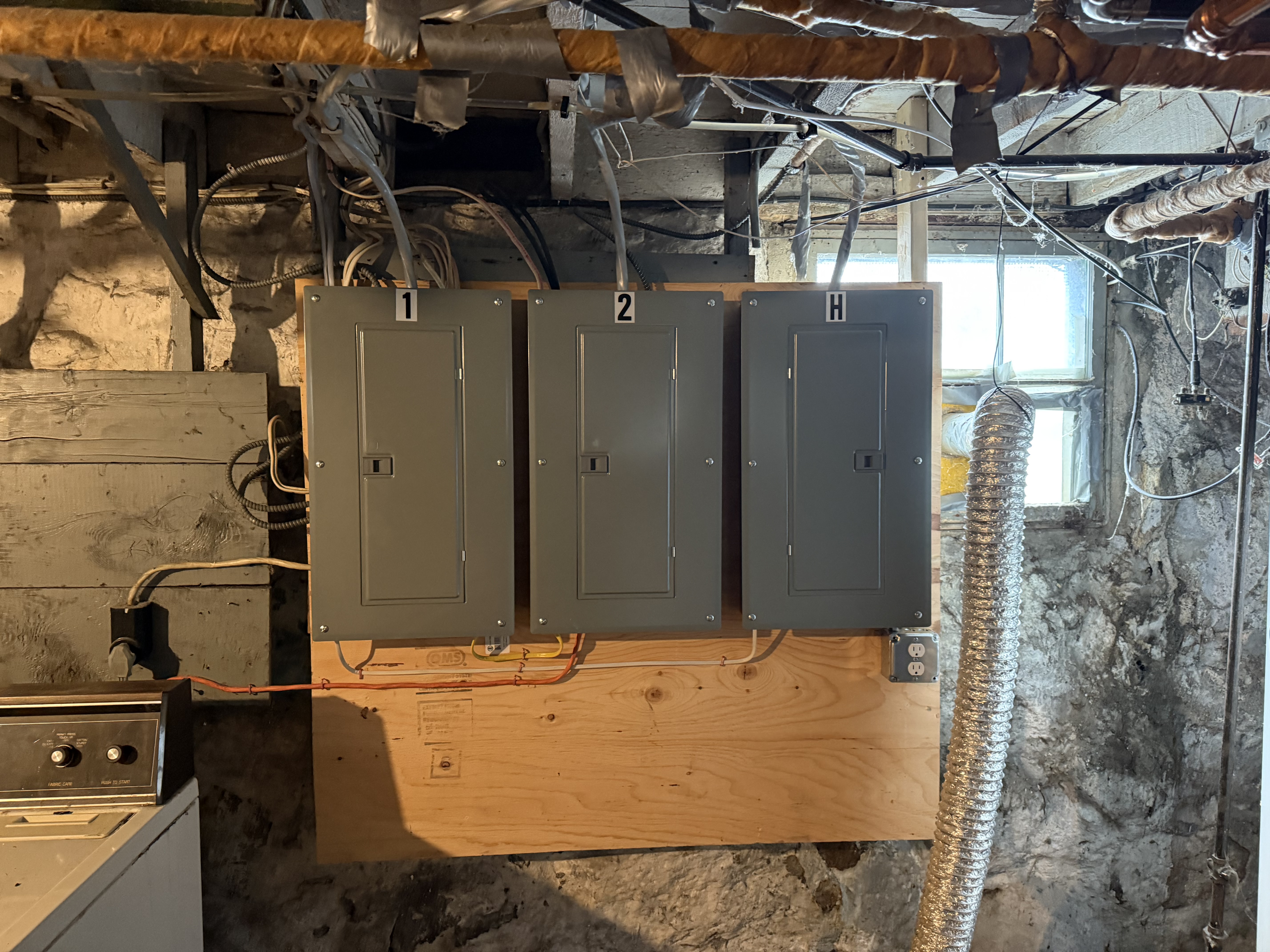
The Breaker Will Not Stay Reset
A breaker that trips once during a restoration is doing its job, and resetting it is a reasonable homeowner move. A breaker that trips again within a minute or two is telling you something different, and the second reset is where people get into trouble.
The harmless reason is load. Everything that was running when the power went out tries to start at the same moment, and motors draw far more current starting than running. Unplug a few things, reset once, and if it holds, you found it. The other reason is a fault: something in that circuit is letting current go where it should not, and the breaker is opening because that is the entire point of a breaker. Water intrusion during a storm does it, especially in basements, crawl spaces and exterior outlets. So does a cord that got pinched or chewed.
So reset it once. If it goes again, leave it off and find out why. A breaker cycled repeatedly against a real fault is being asked to interrupt an arc over and over, which is how an annoying dead circuit becomes a damaged panel. Tracing a circuit back to the fault is an afternoon with a meter, not a guess.
Flickering, Then Dead
When a circuit or a whole leg flickers for a while and then quits for good, the flicker was the useful part. Flicker means a connection that is intermittent rather than open: a wire loose in a terminal, a backstabbed outlet whose spring has relaxed, a breaker whose internal contacts are worn, an aluminum branch splice that has crept.
Every one of those makes heat. A poor connection carrying current is a small heater, and the heat makes the connection worse, which makes more heat. That is the loop that ends in a scorched device or a burnt smell, and it is why flickering that stopped is not the same as flickering that went away. If you had flickering lights before the outage and now that circuit is dead, say so on the call. It changes where we look.
The Fridge Came Back but the Outlets Did Not
Kitchens, bathrooms, garages, basements and exterior outlets are protected, and that protection is often upstream. A single GFCI outlet in the garage can be feeding four other outlets you would never associate with it. A surge during restoration trips the device, everything downstream goes dead, and the reset button is behind a storage shelf in a room you were not thinking about. Press test and reset on every GFCI you can find before you assume anything is broken.
The other cause is an open neutral shared between two circuits, which produces stranger symptoms: lights that brighten when an appliance runs, devices that misbehave rather than simply stop. If your dead outlets come with anything nearby acting oddly, stop testing and call.
What Is Actually Worth Doing Before You Call
Look at your neighbors first. If the houses either side of you are dark too, or half dark, you are almost certainly on the utility side and the answer is the utility, not us. In Taunton that is TMLP, and their outage reporting line is worth using before anything else.
Then open the panel door and look at the breaker faces without touching anything. A tripped breaker usually sits visibly between on and off. Note which ones, note the main, and photograph the panel with your phone, because that photo saves real time on the call. After that, walk the GFCIs: kitchen, baths, garage, basement, outside.
What is not worth doing is opening the panel cover, pulling a device out of a wall, or touching anything at the meter. The service conductors feeding your main are not protected by any breaker you own, and the main lugs stay live with the main switched off. That is the part of the system where a licensed electrician is carrying what you are not: permit authority in Taunton, insurance, and the standing to coordinate with the utility when a meter has to come off.

Why Outages Expose Problems That Were Already There
A storm rarely creates a bad connection. It finds one. Restoration is the hardest moment your service sees all year, because everything that was on when the power dropped tries to start simultaneously, and for a few seconds the current through your service entrance, meter socket, main breaker and panel bus runs far above anything a normal evening produces. A terminal that had been quietly warming for two years finally cooks, and the failure looks like storm damage.
That is why so many panel calls land in the week after weather, and why panel work is often the honest answer to what looks like an intermittent fault. Fuse boxes, obsolete load centers and panels from brands insurers ask about are all common in the older colonials and multi families around here. If an outage keeps handing you the same dead leg or the same nuisance trip, the outage is not the problem. Households that have had two or three of these mornings in a year often end up asking about standby power instead of chasing symptoms.
Questions People Ask Once the Lights Are Back
My neighbors have power and I do not. Is that mine or the utility’s?
It can still be either. A lost service drop or a failed connection at your own weatherhead or meter affects only your house and looks identical from the street. What settles it is a voltage reading at the service, which is live work. If you are the only dark house and nothing in your panel is tripped, treat it as urgent rather than assuming the utility will get to it.
Is it safe to keep resetting a breaker that trips?
Reset it once. If it trips again within a few minutes, leave it off. That breaker is interrupting a real fault, and forcing it closed repeatedly damages the breaker and can damage the panel bus behind it. A dead circuit overnight is a small problem. A cooked load center is not.
Should I be worried about a warm cover plate after an outage?
Yes, and you should stop using that circuit. Warmth at a faceplate, a switch or a panel cover means a connection is making heat instead of passing current, and heat makes the connection worse. Shut the breaker off and have it looked at. This is the one symptom on this whole list that we would rather see today than tomorrow.
None of this requires you to diagnose your own service. It only requires knowing which side of the meter you are on, because that decides whether the next move is the utility, a reset button behind a shelf, or a van in your driveway.
Still dark in half the house?
Tyler works from the service in, finds the actual break rather than swapping parts, and tells you whether the fix is a connection or a panel. Taunton is home ground, and no power calls jump the line.
Free Quote Call Tyler (508) 818-3165Troubleshooting · Emergency panel repair · Every service in Taunton · Recent work