Most people shopping for a home charger start with the hardware and work backward. It is easier to start with your week. How far you drive, when the car is parked, whether it sits inside or out, and whether a second driver shares the plug tell us more about the right circuit than any product page does. A commute that ends at six and leaves at seven has thirteen hours of parked time, and thirteen hours changes the answer considerably.
Somebody calls, tells us which car they ordered, and asks what they need. It is a reasonable opening and it is the wrong end of the problem. Two neighbors on the same street with identical cars can genuinely need different installations, because one of them drives to Boston and back five days a week and the other works from home and takes the car out on Saturdays. The car is the same. The demand on the house is not remotely the same. So before we talk about hardware, Tyler asks about your week, and the answers tend to make the rest of the decision straightforward.
Start With the Miles, Not the Machine
The question that matters most is how far the car travels on an ordinary day, and the honest answer is usually smaller than people expect. A trip to work and back, a school run, an errand loop on the way home. That daily distance is what has to be replaced overnight, and replacing a modest daily distance is a much easier ask than filling an empty battery from nothing.
This is the part that gets lost in the marketing. Nobody arrives home empty every night. You arrive home having used a fraction of the capacity, and the charger only has to put that fraction back before morning. The battery size is close to irrelevant to the sizing conversation. The daily consumption is the number that matters, and it is a number you already know without measuring anything.
Where the miles do change the answer is at the extremes. Somebody driving a long round trip every weekday, or two drivers sharing one connector, is asking for considerably more energy per night, and that pushes toward a circuit with more headroom. Somebody driving locally is often served perfectly well by a modest installation, and telling them otherwise would be selling them something. Tyler will do the arithmetic with you at the kitchen table and let the number decide.

The Hours the Car Is Parked Are the Real Capacity
Think of overnight parked time as a budget you already own. A car that comes home at six and leaves at seven the next morning has a long, quiet window sitting entirely inside the hours when the rest of the house is asleep. Even a modest circuit moves a great deal of energy across that window, which is why the panic about charge rates is mostly misplaced for daily driving.
It also matters for what else is happening in the house. Those hours are when nobody is cooking, the dryer is off, and the water heater has recovered. A load that shows up at eleven at night sits in the quietest part of the day, which is the whole reason demand management works so well for charging and works poorly for things you need on demand.
Where this breaks down is a household with a genuinely tight schedule, like a car that turns around midday for a second trip, or two vehicles alternating on the same connector. That is worth saying at the walk-through, because it changes the sizing and it may change whether one connector serves you at all. It is far easier to plan for a second charging position while the wall is open than to add one later.
Inside, Outside, and What New England Does to the Difference
Where the car sleeps changes the specification more than most people expect. A charger in an attached garage lives in a stable, dry, sheltered spot and has an easy life. A charger on an exterior wall or a post spends its winter in salt spray, road sand and a temperature swing that can cross forty degrees inside a single week, then bakes in July inside the same enclosure that was frozen in February.
That difference shows up in the hardware and in the details around it. Outdoor equipment needs a wet-location rating rather than a roof overhang and a hope, the cable needs to stay flexible when it is genuinely cold instead of turning into something you wrestle with in the dark, and the holster wants to hang high enough that the connector never sits in slush. Every fitting and enclosure in the run gets chosen on the same basis.
Mounting position deserves a minute of thought too. Standing where you park, with the door open, is how you find out whether the cable reaches the port without stretching across the hood or lying on the ground. It takes two minutes at the walk-through and it prevents the single most common complaint we hear about installations somebody else did. Our full approach is on the North Attleborough EV charger installation page.
What Changes When a Second Car Arrives
Households rarely stop at one electric vehicle, and the second one is where planning pays off. Two cars can share a single connector if their schedules genuinely permit it, and plenty of families do exactly that without complaint. But sharing requires somebody to move a cable in the dark on a January night, and the enthusiasm for that fades by about the third week.
Two separate positions is the comfortable answer, and it is dramatically cheaper to allow for during the first installation than to retrofit later. Even if the second unit is years away, the run can be sized, the route can be chosen with a branch in mind, and the panel space can be reserved so nothing has to be undone. That is a small decision now and a large saving later.
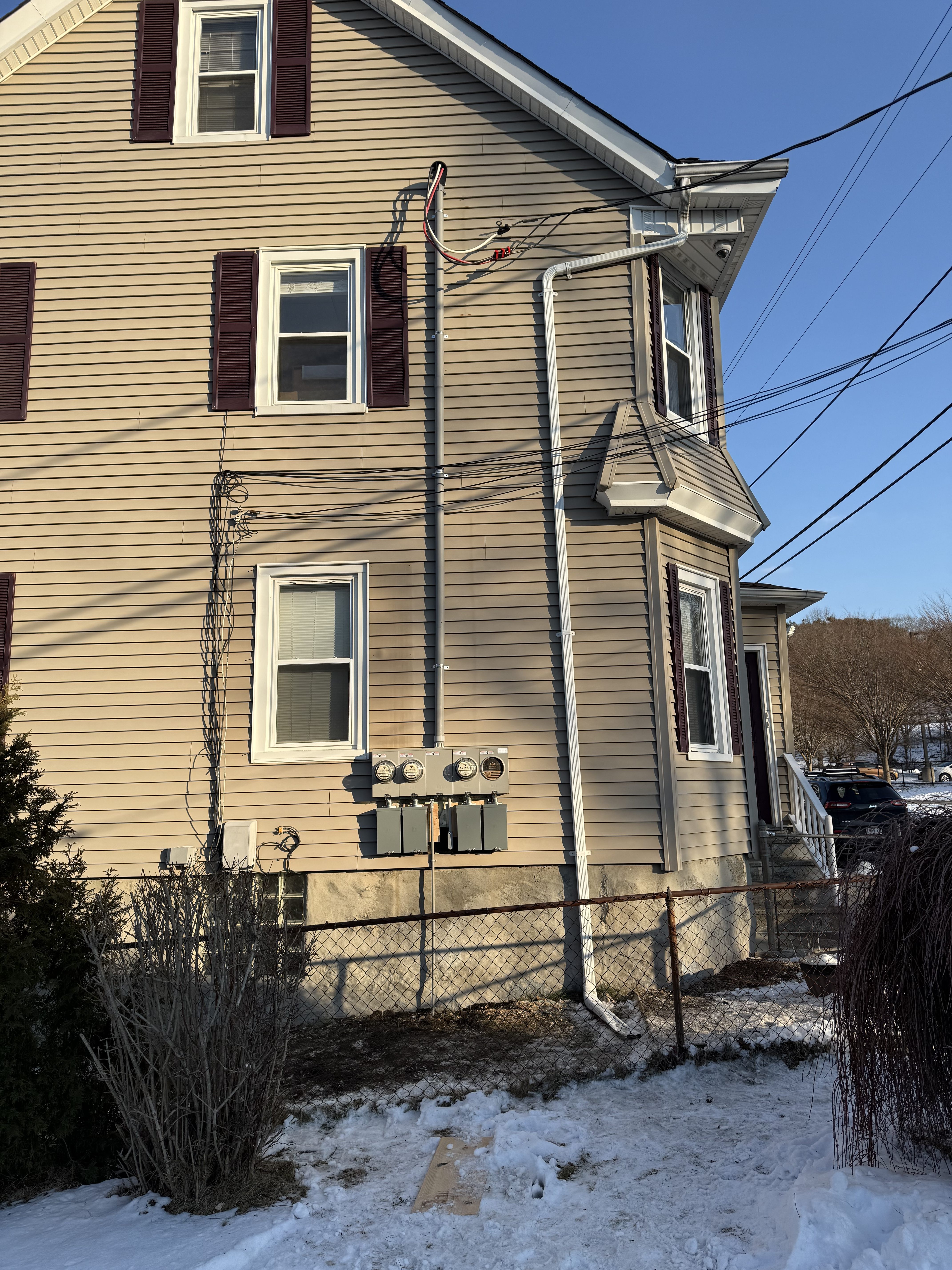
It also feeds back into the service question. One car is often absorbed by an existing service without difficulty. Two cars, especially alongside a heat pump or an electric range, is the point where the arithmetic frequently changes its answer, and where a service change stops being optional. That work is described on the North Attleborough panel upgrade page. Say the second car out loud at the first walk-through even if it is hypothetical, and the whole plan gets built around it.
What This Means for Getting It Booked
The useful preparation before you call is not research into hardware. It is three facts about your life: the ordinary daily distance, the hours the car is parked at home, and where it parks. With those, plus a photo of your panel and a photo of the parking spot, Tyler can usually tell you the shape of the job before anyone drives anywhere.
From there the walk-through settles the rest, and the price comes back in writing with the circuit, the wire, the route and the rate you will actually see all named. Nothing gets ordered until you have agreed to that. If the car is arriving on a date you already know, mention it, because scheduling around a delivery is easier with a few weeks of notice than with a few days.
North Attleborough sits inside our 35-mile radius from Taunton, so this is regular territory rather than a special trip. Non-emergency work here typically schedules within two to four business days. Anything genuinely unsafe, meaning no power, exposed wiring or a burnt outlet, moves to the front of the line and is frequently handled the same day. Text Tyler at (508) 818-3165 or send the details through the contact form, whichever is easier.
Questions Drivers Ask Before Booking
Is a faster charger worth paying for?
It depends on your parked hours. If the car sits home overnight and covers ordinary daily distances, a faster rate mostly buys you a full battery earlier in a night that had plenty of time anyway. Long commutes, shared connectors, or a car that turns around midday are where the extra rate earns its keep.
Can I just use the cord that came with the car?
For light daily driving, sometimes yes, and we will tell you so rather than sell you a unit you do not need. It is slow, which is fine if you drive locally. It is not fine if you need a meaningful amount of range back before morning, and a dedicated circuit is the honest answer then.
How long does the installation itself take?
A straightforward run in a house with capacity is usually an afternoon. A long route to a detached structure, a trench, or a subpanel adds time, and a service change is a separate day with the utility involved. Whichever applies to your house, you will know which one before we start.
Charging at home is one of those purchases where the right answer is genuinely specific to the household. Tell Tyler how you actually drive, and the recommendation follows from that rather than from a catalog. Sometimes the honest answer is a smaller job than you expected, and he will say so.
Tell Tyler how you drive and where you park
A photo of the panel, a photo of the parking spot and a sentence about your week are enough to start. Free walk-through, written quote, permit in the Electrician’s name.
Free Quote Call Tyler (508) 818-3165North Attleborough EV charger installation · Panel upgrades · Every service in town